
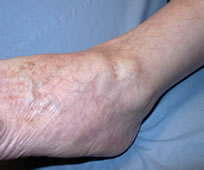
Bilobed ganglion at ankle
Ganglia are the commonest lumps referred to the Foot and Ankle Service. The commonest sites are the dorsolateral aspect of the foot; a few are related to the great toe or the ankle. They are commoner in women, with 55-83% reported in different series. They may occur at any age; the average age is about 40 years, slightly older than in the wrist.
The aetiology and pathogenesis of ganglia remains a controversy unencumbered by evidence.
Diagnosis
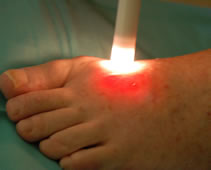
Transillumination in a dorsal foot ganglion
Pain is commoner in reported series of pedal ganglia than in wrist ganglia: 70-84% compared with 26-55%. In studies of pedal ganglia, 8-18% presented with concerns about "the lump" compared with 66% in Westbrook et al’s study of wrist ganglia. However, Westbrook’s series was the only prospective study to investigate patient perceptions and it may be that such a study in the foot would produce different findings to those quoted.
The typical ganglion is a firm, slightly fluctuant swelling which transilluminates. It may be multi-lobular. Clinical diagnosis is possible in the majority of cases; when the diagnosis is uncertain, aspiration may be helpful. Ultrasound is increasingly used to confirm diagnosis. However, there have been no prospective studies of the accuracy of clinical diagnosis. Macdonald (2007) reported on 101 soft tissue lumps in the foot which had beed excised in a tumour service; 39 were ganglia. 20% of lumps thought to be ganglia turned out not to be, and 10% of actual ganglia were not diagnosed as such pre-operatively. However, this only includes ganglia that were excised; clinical diagnosis was outwith the scope of the paper. Where a lump does not have the typical consistency of a ganglion and/or des not transilluminate, it is probably prudent to obtain at least an ultrasound and, if solid, MR before considering excision. If in doubt the opinion of the local soft tissue tumour service should be sought. However, this should be necessary only for a minority of lumps.
Treatment and outcomes
The published reports of treatment of pedal ganglia are all retrospective reports. The largest series is that of Mallick (2006), who reported 57 patients followed up 2-10 years; there was a substantial loss to folow-up. 17 had no active intervention; 9 still had a ganglion at follow-up but only 4 were symptomatic. 13 had simple aspiration; three had subsequent surgical excision, 8 of the remaining 10 had essentially asymptomatic ganglia and in 2 the ganglion had disappeared. Fourteen patients had aspiration and steroid injection; six had surgical excision and four of the remaining eight had residual, minimally symptomatic ganglia. Of 13 patients who underwent surgical excision, 5 had residual minimally symptomatic ganglia.
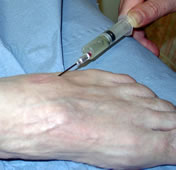
Typical ganglion fluid aspirated
Aspiration and steroid injection are reported in 4 other studies. The recurrence rate was 25-62% (in total 39 recurrences in 91 ganglia – 43%). Kliman and Freiberg (1982) noted that one of their 4 recurrences resolved after a second aspiration/injection and none of the others required further treatment. Pontious et al reported 25 recurrences, of which 13 underwent surgery but the further course of the others was not reported. It seems that even recurrence of a ganglion does not necessarily require surgery. Therefore, recurrence and need for further treatment should be reported as separate outcome measures and the indications for further treatment should be clearly described.
For comparison, Paul and Sochart (1997) randomised patients with wrist ganglia to have aspiration and either hyaluronidase followed by steroid, or steroid alone. The recurrence rates were 11% and 43% respectively. Prior instillation of hyaluronidase has not been reported in the foot and it would be worth repeating this study for pedal ganglia.
None of these conservative studies reported any infections, steroid-induced tissue atrophy or any other complications.
Surgical excision of pedal ganglia was reported in four studies. The recurrence rate was 6-43% (in total 29 recurrences in 166 ganglia – 17.5%). In addition, among 133 patients where complications were reported, there were 12 nerve injuries (9%) and one superficial infection.
Summary and guidelines
There seems no justification for primarily excising pedal ganglia as a routine. The commonest treatment is aspiration and steroid injection but this and the alternatives require fuller evaluation. We tend not to inject smaller ganglia due to concerns about leakage of steroid out of the ganglion. Surgical excision can be offered for recurrence after conservative treatment but the patient must be warned of the risks of recurrence and nerve injury.
Aspiration of a ganglion would seem to be within the capabilities of an appropriately trained primary care doctor, podiatrist, nurse specialist or physiotherapist. However, any such policy should be carefully audited before widespread application.
References
- Ahn JH et al. Operative treatment for ganglion cysts of the foot and ankle. J Foot Ankle Surg 2010; 49:442-5
- Derbyshire RC. Observations on the treatment of ganglia. Am J Surg 1966; 112:635-6
- Esteban, JM et al. Fine needle aspiration in the treatment of ganglion cysts. South Med J 1986: 79:691-3
- Kliman ME, Freiberg A. Ganglia of the foot and ankle. Foot Ankle, 1982; 3:45-6
- Lapidus PW, Guidotti FP. Report on the treatment of one hundred and two ganglions. Bull Hosp Joint Dis 1967; 28:50-7
- Macdonald DJM et al. The differential diagnosis of foot lumps: 101 cases treated surgically in North Glasgow over 4 years. Ann R Coll Surg Engl 2007; 89: 272–275
- Mallick E et al. Outcome of treatment of pedal ganglia. Foot Ankle Surg 2006; 12:89-94
- Paul AS, Sochart DH. Improving the results of ganglion aspiration by the use of hyaluronidase. J Hand Surg 1997; 22:219-21
- Pontious J et al. Ganglions of the foot and ankle. JAPMA 1999; 89:163-8
- Slavitt, JA et al., Ganglions of the foot: a six-year retrospective study and a review of the literature. J Am Podiatry Assoc 1980; 70:459-65.
- Stephen AB et al. A prospective study of two conservative treatments for ganglia of the wrist. J Hand Surg 1999; 24:104-5
- Varley GW et al. Conservative management of wrist ganglia. Aspiration versus steroid infiltration. J Hand Surg 1997; 22:636-7
- Weishaupt D et al. MRI of the foot and ankle: prevalence and distribution of occult and palpable ganglia. JMRI 2001; 14:464-71
- Westbrook AP et al. Ganglia: the patient’s perception. J Hand Surg 2000; 25B:566-7