Fractures of the talus are rare, making up less than 1% of fractures in general trauma practice and 2% of practice in a level 1 trauma centre (Elgafy 2000). However, they are difficult to treat, with a high rate of poor outcomes and complications.
Anatomy
The talus participates in the ankle, subtalar and talonavicular joints, acting as a link between the vertical shank and the obliquely horizontal hindfoot. It serves as an attachment for many ligaments but no muscles, and over 70% of its surface is covered by articular cartilage. Its circulation is therefore somewhat precarious. Blood reaches it from the posterior tibial, dorsal and peroneal arterial trees, entering on the ligaments and the rough area of the neck from an anastomosis in the tarsal canal. The blood supply of the body mostly reaches it by a retrograde route from the neck and is at risk from talar neck fractures. Prasarn (2010) used gadolinuim-enhanced MRI to supplement cadaver dissections, extended previous work and applied their findings to current concepts in surgical approaches to the talus - this is a good starting point to appreciate the vascualr anatomy. Petersen showed that, in cadaver specimens, increasing fracture displacement produced greater compromise to the blood supply.
Inokuchi defined a fracture of the talar body as one in which the main fracture line exited the inferior cortex of the talus through or posterior to the posterior subtalar facet. Nevertheless, some fractures have both neck and body components.
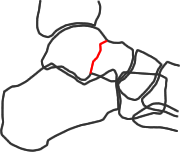
Neck fracture: fracture line exits inferiorly anterior to posterior subtalar facet
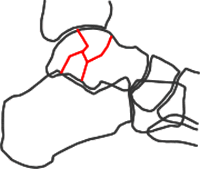
Body fracture: fracture line exits inferiorly into posterior subtalar facet
Pathomechanics
The majority of talar fractures are caused by high-energy trauma such as motor vehicle accidents and falls from a height. The talar neck fracture is sometimes known as “aviator’s astragalus”, from wartime series which described talar fractures sustained in air crashes.
The pathomechanics are somewhat controversial. Traditionally it has been held that fractures of the body and neck are caused by forced dorsiflexion against the anterior lip of the tibial plafond – this was thought to be due to impact from an aircraft rudder bar. However, biomechanical work by Petersen showed that talar neck fractures were reliably produced not by dorsiflexion but pure vertical shear against the plafond.
About 25-35% of talar fractures affect the lateral or posterior processes only; of the rest, fractures of the neck are about twice as common as fractures of the body, and about 10-20% are combined fractures of neck and body.
References
Prasarn ML et al. Arterial anatomy of the talus:a cadaver and gadlinium-enhanced MRI study. FAI 2010; 31:987-93